Findings & checks · 0 flagged
Every scanned point with the score it earned and what moved between them.
First recorded scan — no prior version to compare against.
The primary manifest — the file an agent reads to learn what this artifact does.
prufa-mcp — the QA agent for your vibe-coded app
<!-- mcp-name: io.github.prufa-dev/prufa-mcp -->
Vibe-coded apps ship faster than anyone can review them. In June 2026 we audited 49 fresh Show HN launches — 38 had a critical bug on day one: a broken signup, a silent console error, analytics that never fired, a consent banner that did nothing.
Prufa is the agent that catches those before your users do. Point it at a URL and it audits the things humans skip when they're moving fast — broken flows, JS console errors, missing tracking, consent violations, security headers, mobile tap targets, accessibility — and hands back machine-verified findings, graded A–F. This repo is the open-source MCP server that wires that audit straight into your coding agent.
30-second demo
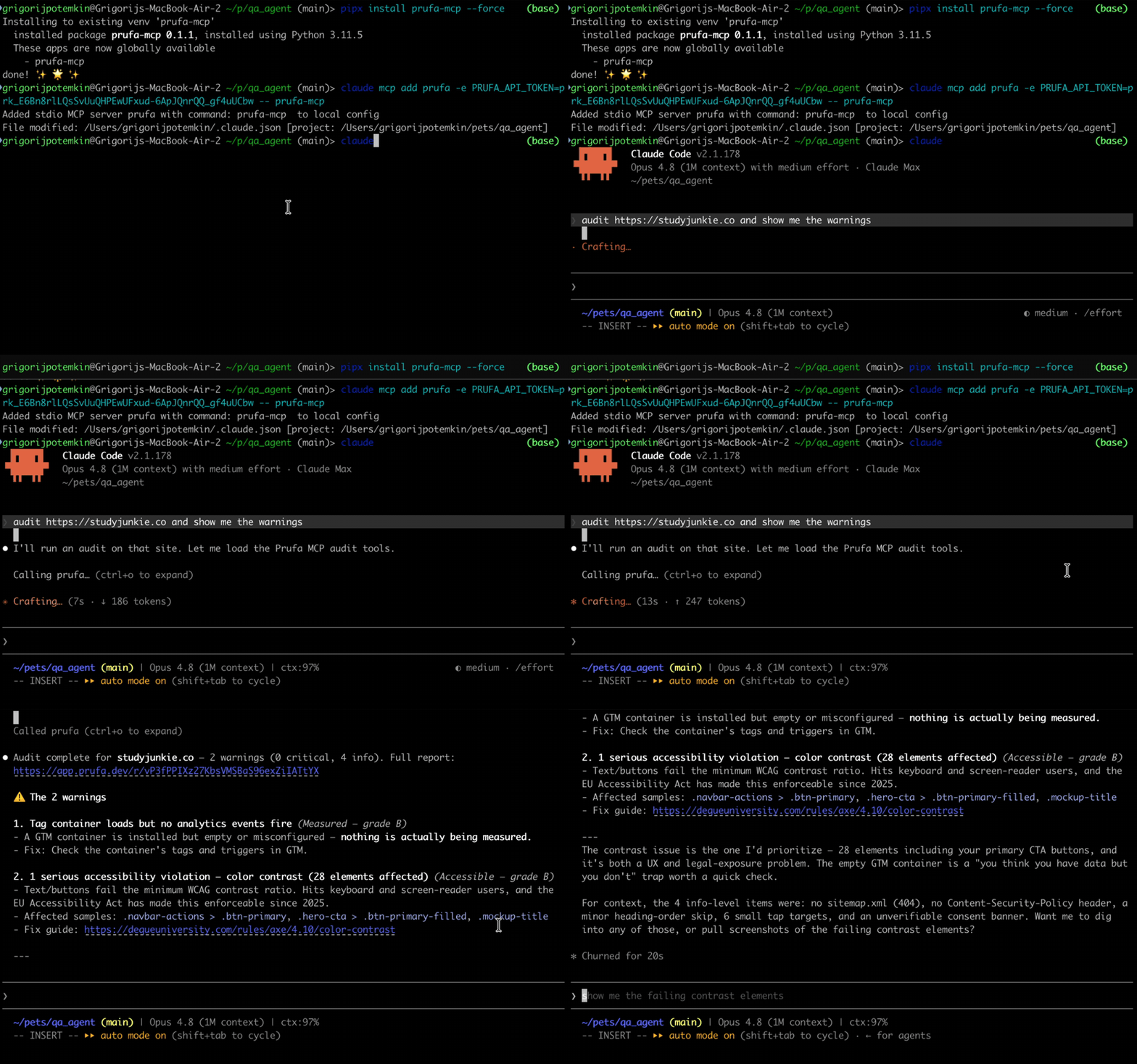
What an audit gives you
Ask your agent to audit https://yourapp.com and prufa_run_audit returns one JSON report. Findings are grouped into graded sections, each finding carries a severity, the impact (why it matters), and a fix hint. Real output, trimmed:
{
  "url": "https://yourapp.com",
  "headline": "2 warnings found",
  "counts": { "critical": 0, "warning": 2, "info": 5 },
  "sections": [
    { "label": "Works",     "grade": "C", "counts": { "warning": 2, "info": 1 } },
    { "label": "Fast",      "grade": "A" },
    { "label": "Found",     "grade": "A" },
    { "label": "Compliant", "grade": "A" }
  ],
  "check_results": [
    {
      "check_id": "ux",
      "findings": [{
        "severity": "warning",
        "title": "2 javascript console error(s) during page load",
        "impact": "Errors at load time often mean broken features visitors never report.",
        "evidence": { "count": 2, "sample": [
          "Access to XMLHttpRequest at 'https://api.fontshare.com/...' blocked by CORS policy",
          "Failed to load resource: net::ERR_FAILED"
        ]}
      }]
    },
    {
      "check_id": "mobile",
      "findings": [{
        "severity": "warning",
        "title": "13 tap target(s) smaller than 24px",
        "impact": "Fingers are not cursors — undersized buttons mean mis-taps on exactly the elements you want pressed.",
        "fix_hint": "Give interactive elements at least 24x24px of hit area (WCAG 2.5.8)."
      }]
    },
    {
      "check_id": "security",
      "findings": [{
        "severity": "info",
        "title": "no Content-Security-Policy header",
        "impact": "Without a CSP, one injected script owns the page — and every third-party tag you load is trusted completely.",
        "fix_hint": "Start with a report-only CSP and tighten from real violation reports."
      }]
    }
  ],
  "report_url": "/r/G82RpzTi_zn-o71_XoMLCprP7uvCQP87"
}
report_url is a shareable HTML version of the same report. The full payload also includes tracking, consent, seo/aeo, a11y, forms, and detected user flows — see the OSS surface below.
Install
The package is on PyPI. Install it globally with pipx (recommended — isolated venv, exposes the prufa-mcp binary on your PATH) or into a project venv with pip:
# Recommended — global install, isolated venv
pipx install prufa-mcp

# Or, into your project venv
pip install prufa-mcp

# Pin a specific version with ==, e.g. pipx install prufa-mcp==0.1.3

# Verify the binary is on PATH
which prufa-mcp
# Should print something like: /Users/you/.local/bin/prufa-mcp
You also need a free Prufa API key. The first audit is free, no card required.
- Sign in at prufa.dev (Google OAuth)
- Create an API key from the dashboard
Wire into your agent
The MCP server runs as a stdio subprocess, spawned by your agent on first use. The cleanest way to register it is claude mcp add (Claude Code's built-in command — it writes the config to ~/.claude.json correctly, which the ~/.claude/mcp.json path does NOT).
Claude Code (recommended path)
# Get the absolute path of the binary (use whatever `which prufa-mcp` returned)
PRUFA_BIN=$(which prufa-mcp)

# Add the MCP server. The token stays out of your shell history.
read -s -p "Prufa API token: " PRUFA_TOKEN && echo
claude mcp add \
  --scope user \
  --env "PRUFA_API_TOKEN=$PRUFA_TOKEN" \
  prufa \
  -- "$PRUFA_BIN"
Restart Claude Code (config is read at startup), then verify:
/mcpYou should see prufa listed as Connected, with prufa_run_audit and prufa_get_report as available tools.
Cursor / Cline / Continue (hand-edit .mcp.json)
In your project root or in ~/.config/Claude/ etc.:
{
  "mcpServers": {
    "prufa": {
      "command": "/Users/you/.local/bin/prufa-mcp",
      "env": {
        "PRUFA_API_TOKEN": "your-prufa-api-key"
      }
    }
  }
}
Restart the host app. The command path must be the absolute binary path (not ~, not $()) — those don't expand in MCP config.
Prefer config files to env vars? Drop your token in ~/.config/prufa/mcp.json instead — see ADVANCED.md.Use it
In your agent:
> audit https://my-vibe-coded-app.com and show me the criticals
> run prufa on my staging deploy
> fetch the report for the audit I just ran
prufa_run_audit with wait=true (the default) blocks until the audit completes and returns the JSON report directly — typically 25–60s for a public page. If you set wait=false, the call returns immediately with the queued state plus a share_token you can poll with prufa_get_report.
What you get (the OSS surface)
| Tool | What it does |
|---|---|
prufa_run_audit(url, wait=true) | Triggers a public-page audit, polls until done, returns findings JSON. The wait flag is honored — it actually blocks. |
prufa_get_report(report_id) | Fetches a report. report_id is EITHER the run UUID (from prufa_run_audit's run_id field) OR the share_token (the slug from /r/<token> in the audit creation report_url). The slug is what you'll see most often — use that. |
Beyond the snapshot
A free audit is a snapshot — it looks at your app once. The hosted product turns that into something that walks your flows and watches for regressions:
- Deep QA flows — describe a journey in plain language ("log in, add to cart,
check out"); Prufa compiles it to a reviewable spec and runs it end-to-end in a real browser, asserting every step.
- Monitors — re-run any audit or flow on a schedule and get alerted the
moment a grade drops or a flow breaks.
- Slack alerts, workspaces, billing, gremlin runs — ~22 more tools (the MCP surface is 24 tools total; 2 ship here, the rest are hosted).
The audit already detects your flows for you (the flows check in every report). Turn them on at [prufa.dev](https://prufa.dev) — free audits look, monitors walk.
Examples
Three runnable scripts in examples/:
examples/nextjs-app/— audit a deployed Next.js appexamples/vite-spa/— audit a Vite SPA (focuses on client-side routing audits)examples/stripe-checkout/— audit a Stripe-checkout page (payment-flow verification)
Each is a copy-pasteable demo:
export PRUFA_API_TOKEN=...
python examples/nextjs-app/audit.py https://your-nextjs-app.com
GitHub Action
Fail a PR when Prufa finds a critical regression:
# .github/workflows/prufa-scan.yml
name: Prufa scan
on: [pull_request]
jobs:
  audit:
    runs-on: ubuntu-latest
    steps:
      - uses: actions/checkout@v4
      - uses: actions/setup-python@v5
        with:
          python-version: "3.11"
      - run: pip install prufa-mcp
      - name: Run audit
        env:
          PRUFA_API_TOKEN: ${{ secrets.PRUFA_API_TOKEN }}
        run: |
          python -c "
          import asyncio, sys
          from prufa_mcp.audit import run_audit
          report = asyncio.run(run_audit(url='${{ secrets.STAGING_URL }}', wait=True))
          print(report.get('headline', 'audit complete'))
          criticals = report.get('counts', {}).get('critical', 0)
          if criticals:
              print(f'::error::Prufa found {criticals} critical finding(s)', file=sys.stderr)
              sys.exit(1)
          "
See examples/prufa-scan.yml for the full template.
License
Apache-2.0. See LICENSE. Contributions welcome — see CONTRIBUTING.md. </content> </invoke>