Findings & checks · 0 flagged
Every scanned point with the score it earned and what moved between them.
First recorded scan — no prior version to compare against.
The primary manifest — the file an agent reads to learn what this artifact does.
SwiftMCP
A Swift Package that implements an MCP (Model Context Protocol) client for iOS and macOS, enabling native API integration through a JSON-RPC interface. The package also includes an OpenAI-compatible function calling bridge.
Features
- Open source function definitions for Apple's native APIs like HealthKit
- JSON-RPC 2.0 compliant interface
- Some test coverage
Requirements
- iOS 15.0+ / macOS 12.0+
- Swift 6.0+
- Xcode 15.0+
Installation
Swift Package Manager
Add the following dependency to your Package.swift file:
dependencies: [
    .package(url: "https://github.com/compiler-inc/SwiftMCP.git", from: "1.0.0")
]
Architecture
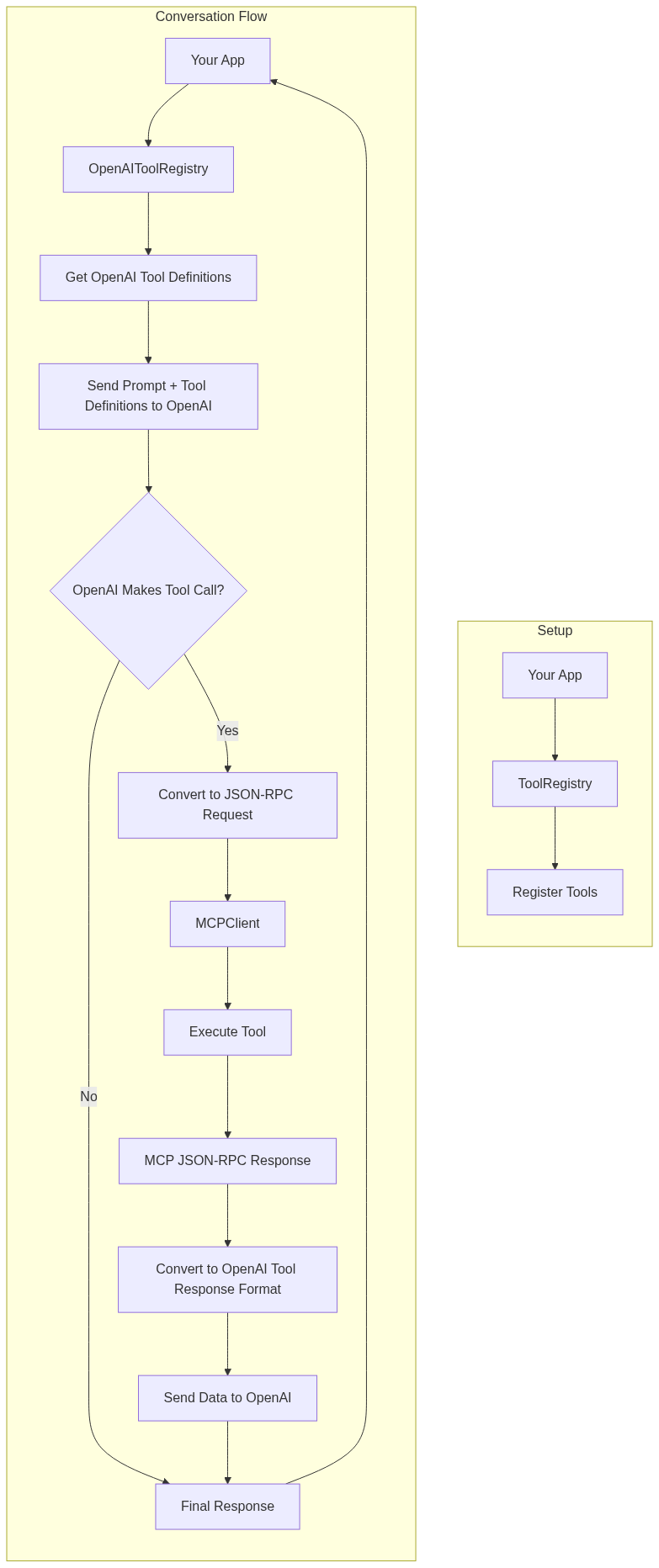
Usage
Basic Setup
import SwiftMCP

// Create a tool registry
let registry = ToolRegistry()

// Create an MCP client with a response handler
let client = MCPClient(toolRegistry: registry) { response in
    print("Received response: \(response)")
}

// Register tools
do {
    let healthKitTool = try HealthKitTool()
    registry.register(tool: healthKitTool)
} catch {
    print("Failed to initialize HealthKit tool: \(error)")
}
OpenAI Integration
This example demonstrates:
- Setting up the MCP client with HealthKit tool
- Creating an OpenAI bridge and registering the tool schema
- Converting MCP tools to OpenAI function definitions
- Sending an initial request to OpenAI
- Processing any tool calls through MCP
- Sending the tool results back to OpenAI for final summarization
The flow allows OpenAI to:
- Request step count data using the HealthKit
getDataaction - Request workout data using the HealthKit
getWorkoutsaction - Receive the actual health and workout data through MCP
- Provide a natural language summary of the data
import SwiftMCP
import OpenAI

// 1. Set up MCP client and tools
let registry = ToolRegistry()
let client = MCPClient(toolRegistry: registry) { response in
    print("Received response: \(response)")
}

// Initialize HealthKit tool
let healthKitTool = try HealthKitTool()
registry.register(tool: healthKitTool)

// 2. Set up OpenAI bridge
let openAIRegistry = OpenAIToolRegistry()
let healthKitSchema = JSONSchema(
    type: .object,
    properties: [
        "action": .init(type: .string, enum: ["getData", "getWorkouts"]),
        "dataType": .init(type: .string, description: "Type of health data to retrieve (e.g., stepCount, heartRate)"),
        "timeRange": .init(type: .string, enum: ["today", "yesterday", "this_week", "last_week"]),
        "workoutType": .init(type: .string, enum: ["running", "cycling", "walking"]),
        "includeRoutes": .init(type: .boolean)
    ],
    required: ["action"]
)

// Register the HealthKit tool with its schema
openAIRegistry.registerTool(healthKitTool, schema: healthKitSchema)

// 3. Get OpenAI function definitions
let functions = try openAIRegistry.getOpenAIFunctions()

// 4. Create OpenAI client and chat request
let openAI = OpenAI(apiToken: "your-api-key")
let query = "What was my step count today and how many calories did I burn in my last run?"

let chatRequest = ChatRequest(
    model: .gpt4o,
    messages: [
        .init(role: .user, content: query)
    ],
    functions: functions,
    functionCall: "auto"
)

// 5. Send request to OpenAI
let result = try await openAI.chat(request: chatRequest)

// 6. Handle any tool calls from OpenAI
if let toolCalls = result.choices.first?.message.toolCalls {
    // Process each tool call through MCP
    let toolResponses = try await openAIRegistry.handleToolCalls(toolCalls)

    // 7. Send follow-up request to OpenAI with tool results
    let followUpRequest = ChatRequest(
        model: .gpt4,
        messages: [
            .init(role: .user, content: query),
            result.choices.first!.message,
            .init(role: .assistant, content: nil, toolCalls: toolResponses)
        ]
    )

    // 8. Get final summarized response
    let finalResult = try await openAI.chat(request: followUpRequest)
    print(finalResult.choices.first?.message.content ?? "No response")
}
Note: Make sure to handle errors appropriately and replace "your-api-key" with your actual OpenAI API key.
OpenAI Function Calling Bridge
// Create and set up the OpenAI bridge
let openAIRegistry = OpenAIToolRegistry()

// Register your MCP tools with their schemas
openAIRegistry.registerTool(healthKitTool, schema: healthKitToolSchema)

// Get OpenAI function definitions
let functions = try openAIRegistry.getOpenAIFunctions()

// Handle OpenAI tool calls
let toolCalls: [OpenAIBridge.ToolCall] = ... // from OpenAI response
let toolResponses = try await openAIRegistry.handleToolCalls(toolCalls)
Handling JSON-RPC Requests
// Example JSON-RPC request for health data
let request = JSONRPCRequest(
    jsonrpc: "2.0",
    method: "healthKit",
    params: [
        "action": .string("getData"),
        "dataType": .string("stepCount"),
        "timeRange": .string("today")
    ],
    id: "1"
)

// Example JSON-RPC request for workouts
let workoutRequest = JSONRPCRequest(
    jsonrpc: "2.0",
    method: "healthKit",
    params: [
        "action": .string("getWorkouts"),
        "workoutType": .string("running"),
        "includeRoutes": .bool(true),
        "timeRange": .string("last_week")
    ],
    id: "2"
)

if let data = try? JSONEncoder().encode(request) {
    try await client.handleIncomingMessage(data: data)
}
Creating Custom Tools
class CustomTool: MCPTool {
    let methodName = "custom/method"

    func handle(params: [String: JSON]) async throws -> [String: JSON] {
        // Implement your custom functionality here
        return [
            "status": .string("success"),
            "result": .object(["data": .string("your data here")])
        ]
    }
}
Available Tools
HealthKitTool
Provides comprehensive access to HealthKit data through the MCP interface.
#### Methods
healthKit
- Actions:
getData: Retrieve health metrics
- Parameters:
dataType: Type of health data to retrieve (e.g., "stepCount", "heartRate")timeRange(optional): Predefined range ("today", "yesterday", "this_week", etc.)duration(optional): ISO 8601 duration string (e.g., "P7D" for 7 days)- Returns:
dataType: The type of data retrievedunit: The unit of measurementsamples: Array of data points with values and timestamps
getWorkouts: Retrieve workout data- Parameters:
workoutType(optional): Type of workout to filter by (e.g., "running", "cycling")includeRoutes(optional): Boolean to include GPS route datatimeRange(optional): Predefined rangeduration(optional): ISO 8601 duration string- Returns:
workouts: Array of workout data including:type: Workout typestartDate: Start timestampendDate: End timestampduration: Duration in secondsdistance(optional): Distance in meterscalories(optional): Energy burned in kilocaloriesroute(optional): Array of GPS coordinates with timestamps
Error Handling
The package uses the MCPError type for error handling, which includes:
toolNotFound: When the requested method doesn't existinvalidParams: When the request parameters are invalidtoolError: Generic error case for tool-specific errors with a descriptive messagejsonParsingError: When JSON parsing failsinvalidRequest: When the JSON-RPC request format is invalid
Contributing
I want to add as many iOS APIs as possible to this repo. The goal is to create a comprehensive collection of MCP-compatible tools for iOS development.
Any contributions are welcome! Please feel free to submit a PR.
License
This project is licensed under the MIT License - see the LICENSE file for details.
MLX Swift Integration
Overview
SwiftMCP now includes support for function calling (tool use) with MLX models running locally on-device. This feature allows you to leverage the power of local large language models with tool use capabilities without relying on external API services.
Setup
To use MLX Swift function calling, first add the MLX Swift dependency to your project:
dependencies: [
    .package(url: "https://github.com/compiler-inc/SwiftMCP.git", from: "1.0.0")
    .package(url: "https://github.com/ml-explore/mlx-swift", from: "0.21.0")
]
Basic Usage
This example demonstrates:
- Setting up the MLX tool registry
- Loading and initializing an MLX model
- Registering tools with the MLX bridge
- Generating text with tool calling capabilities
import SwiftMCP
import MLX

// 1. Set up MLX Tool Registry
let mlxRegistry = MLXToolRegistry()

// 2. Register tools
let weatherTool = WeatherTool()
mlxRegistry.registerTool(weatherTool, schema: WeatherTool.getJSONSchema())

// 3. Create model handler and load model
let modelType = MLXModelFactory.detectModelType(from: modelURL)
let modelHandler = MLXModelFactory.createModelHandler(
    modelType: modelType,
    toolRegistry: mlxRegistry
)

try await modelHandler.loadModel(from: modelURL)

// 4. Generate text with function calling
let prompt = "What's the weather like in San Francisco?"
let response = try await modelHandler.generateWithFunctionCalling(
    prompt: prompt,
    systemPrompt: "You are a helpful assistant with access to weather information.",
    parameters: [
        "temperature": 0.7,
        "max_tokens": 1024
    ]
)

print(response)
Supported Models
The MLX integration currently supports the following model architectures:
- Mistral (7B, 8x7B)
- Llama (2, 3)
- Phi
Model Loading
Models need to be in the MLX format, which can be obtained by converting models from Hugging Face using the MLX conversion tools. For detailed instructions, visit the MLX repository.
Creating Custom Tools for MLX Models
Creating tools for MLX models follows the same pattern as other tools in SwiftMCP:
class CustomTool: MCPTool {
    let methodName = "custom/method"

    func handle(params: [String: JSON]) async throws -> [String: JSON] {
        // Implement your custom functionality here
        return [
            "status": .string("success"),
            "result": .object(["data": .string("your data here")])
        ]
    }

    static func getJSONSchema() -> String {
        return """
        {
            "type": "function",
            "function": {
                "name": "custom_method",
                "description": "Performs a custom operation",
                "parameters": {
                    "type": "object",
                    "properties": {
                        "param1": {
                            "type": "string",
                            "description": "First parameter"
                        },
                        "param2": {
                            "type": "number",
                            "description": "Second parameter"
                        }
                    },
                    "required": ["param1"]
                }
            }
        }
        """
    }
}